Press kit
BioReservoir — a real fly brain, simulated live, answering visitor questions
Everything on this page is for journalists and editors covering fly.igdigi.com. Contact hello@igdigi.com for anything not covered here — interviews, additional images, or access for verification.
About IG Digital Lab
IG Digital Lab is a software and AI automation agency in Sacramento, California. We put AI inside the process a business already runs on and build the chain around it end to end: custom software and integrations, websites and web apps, mobile apps, AI for calls and chat, phone-to-CRM workflow automation, servers and support, devices and smart spaces, and visibility in AI search (SEO and AEO). Trading name of IGGO, LLC, founded 2025.
BioReservoir is IG Digital Lab's research lab. Each time a new brain-wiring map is published, the lab builds an experiment on it, publishes the method, and scores every result against real controls — a rewired connectome, a random graph and a no-connectome baseline.
Founder

Igor Golubev is the founder and AI Systems Architect of IG Digital Lab, a Sacramento, California AI automation company. He has built websites and run IT and digital projects since 2012, including four years running his own digital marketing agency in SEO, web development and digital strategy. He builds the AI systems himself.
Igor Golubev is the founder and AI Systems Architect of IG Digital Lab, a Sacramento, California company building AI automation for small and mid-sized businesses. He has been building websites and running IT and digital projects since 2012. Before founding IG Digital Lab, he spent four years running his own digital marketing agency, handling SEO, web development and digital strategy for clients — first-hand business experience, not theory. He works hands-on across the stack: LLM integration, voice AI, retrieval-augmented generation and workflow automation, plus the DevOps that keeps it running in production day to day. He runs roughly twenty live AI systems himself, most of them originally built to solve his own operating problems before any client asked for the same thing.
Project images
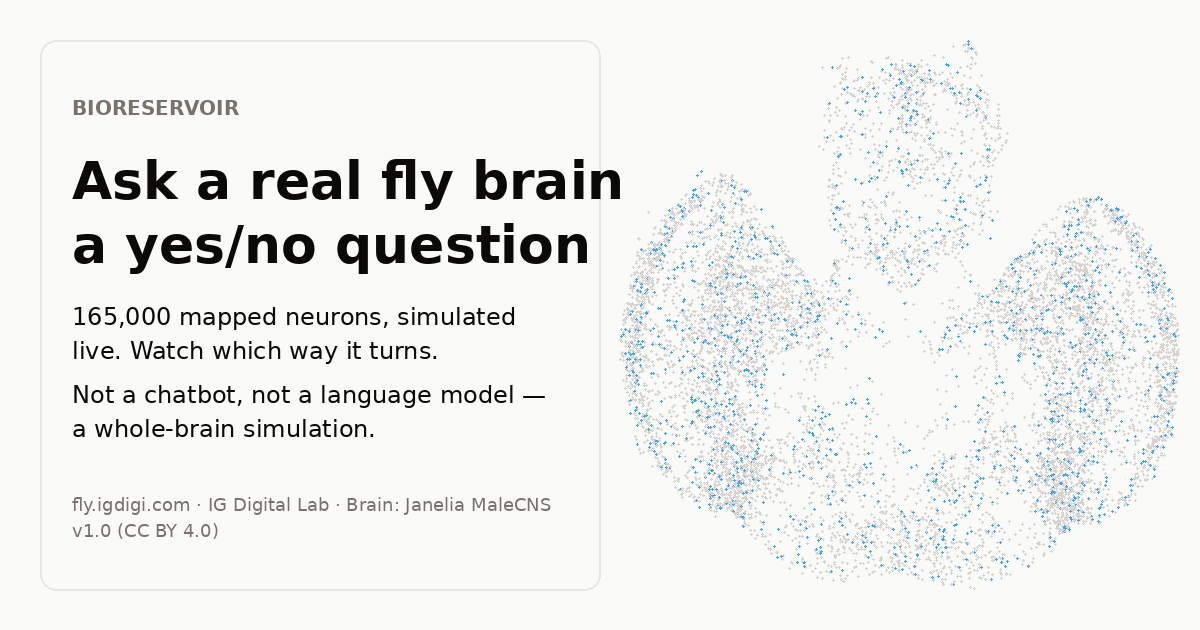
Video
A 24-second screen capture of one full run — the question being typed, the spike replay, the per-answer counts and the fly turning. 1080×1920, H.264, with music (Mixkit Free License, attribution not required). Free for editorial use covering this project.
Download the capture (10 MB, MP4)
These images are provided for editorial and press use covering BioReservoir and IG Digital Lab. Credit "IG Digital Lab" where practical.
Key numbers
| Metric | MaleCNS (male) | BANC (female, comparison only) |
|---|---|---|
| Neurons (proofread only) | 165,122 | 114,456 |
| Connections (≥5 synapses) | 6,235,682 | 1,395,876 |
| Synapses | 89,731,551 | 17,903,013 |
| Mean degree (connections/neuron) | 37.76 | 12.20 |
Methodology: both connectomes are filtered to proofread neurons only, with connections thresholded at ≥5 total synapses — one identical rule applied to both datasets. The female connectome's lower connection and synapse counts reflect a less complete public reconstruction, not a biological difference between the sexes; the two are not directly comparable as "brain size." Full derivation: the data page.
Simulation: a leaky integrate-and-fire network, 250 simulated milliseconds per trial, parameters ported unchanged from Shiu et al. (2024). Driving the real sugar-sensing neurons fires the real proboscis-extension neuron (MN9) at 128.5 ± 21.3 Hz (mean ± std, 10 trials, 150 Hz input) versus 0 spikes at no input; adding bitter input suppresses that firing by 96.8%. Full validation, including where it fails (the female connectome), is live at /api/validation and explained on /data.
Sources
| What | Citation |
|---|---|
| Male connectome (MaleCNS v1.0) | Berg, Beckett, Costa et al. Sexual dimorphism in the complete connectome of the Drosophila male central nervous system. bioRxiv (2025). doi:10.1101/2025.10.09.680999. Data: male-cns.janelia.org, CC BY 4.0. |
| Female connectome (BANC) | Bates, Phelps, Kim et al. Distributed control circuits across a brain-and-cord connectome (preprint). Harvard Dataverse, doi:10.7910/DVN/8TFGGB, CC BY 4.0. |
| Simulation method | Shiu, Sterne, Spiller et al. A Drosophila computational brain model reveals sensorimotor processing. Nature 634, 210–219 (2024). doi:10.1038/s41586-024-07763-9. |
| Code | Open source: github.com/igdigitallab/bioreservoir, Apache License 2.0. Third-party data and models keep their own licenses (see the repository's NOTICE file). |
Contact
hello@igdigi.com — press inquiries, interviews, additional images, verification requests. Email only; there is no press contact form.
Disclosure
BioReservoir and IG Digital Lab are not affiliated with or endorsed by Janelia, HHMI, BANC or FlyWire.